
ERCP
Endoscopic retrograde
cholangio-pancreatography
Overview
ERCP stands for ‘endoscopic retrograde cholangio-pancreatography’, a highly specialised procedure that’s performed only in specific facilities with appropriately trained Personnel. An ERCP is performed primarily for therapeutic purposes, usually to treat conditions associated with the biliary system or pancreas. These include complicated gallstone disease that may lead to jaundice or tumours of the liver, biliary tree and pancreas.
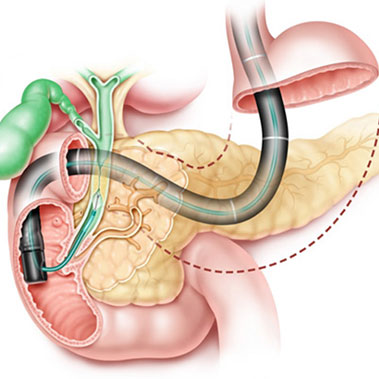
The procedure
The endoscopic retrograde cholangio-pancreatography procedure will usually last between 30 and 60 minutes. As the patient, you will usually be positioned on your stomach (prone) or on your side (lateral). The procedure is performed under deep sedation or general anaesthetic, and can be performed as a day procedure. Occasionally, you’ll be required to stay overnight.
Preparing for ERCP
You’ll need to avoid eating solids for at least 6 hours prior to your procedure. You may have clear fluids until 2 hours before your procedure.
Recovery
After your procedure, you’ll be taken to the recovery area. Before you’re discharged, your endoscopist will explain the results of the procedure to you, and you’ll be required to make a follow-up appointment. You’ll be told if you need to make any changes to your diet during the hours or days after going home.
In the 24 hours following your procedure, you should not:
- Drive
- Operate heavy machinery
- Drink alcohol
- Take sleeping tablets
- Go to work
- Sign any contracts or legal documents
- Be responsible for small children or dependents
What are the risks?
The main potential risks of the procedure are:
- Upper gastro-intestinal perforation
- Pancreatitis
- Bleeding


